ADHD & CPTSD: What is the difference?
Differential diagnosis is the process of distinguishing between conditions that share similar symptoms in order to arrive at the most accurate explanation for a client’s experience. In my practice, one of the more challenging examples of this is differentiating Complex Post-Traumatic Stress (CPTSD) from Attention Deficit Hyperactivity Disorder (ADHD). Both of these diagnoses share significant overlap, including rapid mood fluctuations, impulsivity, rumination, difficulty concentrating, and difficulty establishing and maintaining friendships. Even more complicated is the fact that living with ADHD often leads to experiences that can result in CPTSD.
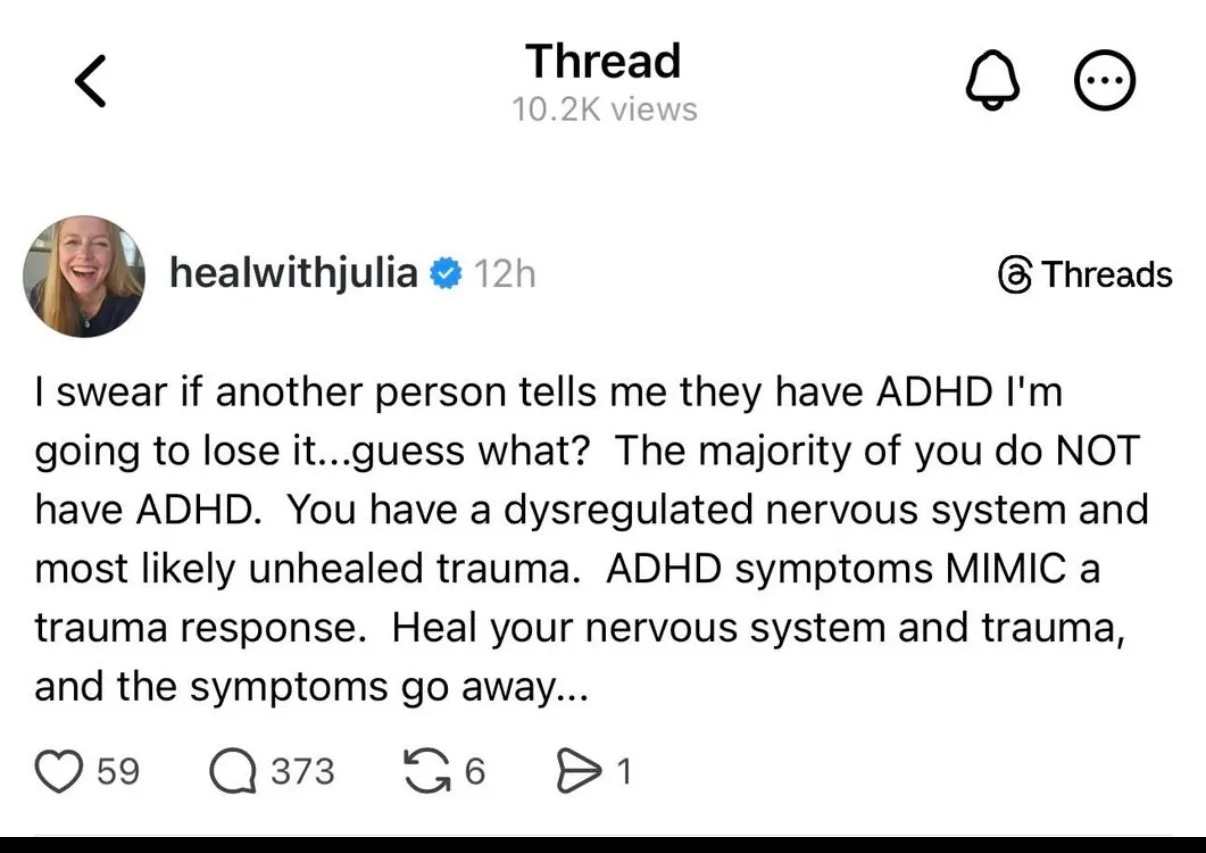
It is important to clarify this distinction though, as I believe we have entered an age of backlash to our emerging understandings of neurodiversity, where misinformation paints a picture that diagnoses like ADHD and Autism are largely fabricated. In my last post, Truthisms as the New Therapy, I called into question the dubious nature of some wellness coaches and the pseudoscience they occasionally preach. This post is very much a follow up, as oftentimes ADHD gets presented as a specific blend of traumas and habit patterns, rather than the impacts of true neurodevelopmental dysfunction.
Looking to the brain and body is crucial in understanding the difference between ADHD and CPTSD. Whereas PTSD often presents as intense emotional and physiological responses to discrete traumatic moments, CPTSD is the accumulation of chronic traumatic experiences, varying in severity over time, which result in both learned patterns of maladaptive behavior and neurobiological disruptions to our body’s stress responses. This can include increased reactivity in the amygdala, with the brain identifying threats before it has a chance to fully process, as well as dysregulation of cortisol, associated with states of hyperactivity or emotional blunting. In essence, the mind has become so acclimated to heightened stress that regulating one’s internal state is an immense challenge. These changes in biological processes are only one aspect of CPTSD though, with much of the trauma survivor’s memories and experiences coloring their perspective on social relationships and general humanity, with distrust and lack of feelings of safety compounding the unseen work of the body.
ADHD, on the other hand, is a neurodevelopmental disorder impacting several brain regions including the prefrontal cortex, cerebellum, basal ganglia, and limbic system. On average, those with ADHD tend to show delayed maturation and reduced volume of the prefrontal cortex compared to their neurotypical peers, resulting in significant difficulties with inhibition, emotional processing, and challenges with organization, task initiation, poor working memory, and ability to focus (among many other things). Along with this, emerging research demonstrates that those with ADHD tend to struggle remaining in the Task Positive Network (TPN), the part of the brain responsible for sustaining attention on a given task, often instead gravitating back towards the Default Mode Network (DMN), the part of the brain that has to do with free association or daydreaming. Lastly, and beyond the scope of this post, is the fact that ADHD is correlated with a host of other adverse experiences, such as poor coordination, lower interoception, dysgraphia, possibly related to the aforementioned impacts on the cerebellum, as well as auditory processing disorders. The list goes on for quite a while…
Still, in terms of how symptoms present themselves, these structural differences don’t fully capture what distinguishes the two diagnoses. In either case, we will likely be dealing with someone who experiences high levels of distractibility, emotional overwhelm, and low self-esteem. Thus it is important to understand the timing of when symptoms began to present themselves. While we are certainly learning more about late diagnosis ADHD, diagnosis requires symptoms to have been present in childhood (though this gets nuanced with late diagnosis…a post for another time), whereas CPTSD’s onset is directly related to traumatic experiences. Put simply, without trauma, there is no CPTSD, whereas ADHD presents itself as the demands of the child increase. Environmental factors can exacerbate the symptoms of ADHD, but it is widely understood that ADHD emerges from the complex interplay of genetics, biology, and environmental experiences, not from experience alone.
Secondly, the treatments used for each diagnosis further cement the reality that these are distinct experiences. Stimulant medication is typically considered the gold standard first line defense in treating ADHD. I’m not saying every person with ADHD needs them, and I absolutely respect every individual’s autonomy over their body and mind. But for many people with ADHD, stimulant medication results in clear benefits often immediately. This isn’t necessarily true for someone with CPTSD. Paradoxically, stimulant medication tends to help those with ADHD feel more relaxed, whereas the extra energy may be uncomfortable for the overactive nervous system of someone with CPTSD. Additionally, working on trauma healing with an ADHD person may be helpful in unburdening aspects of shame accumulated over the years, but may ultimately prove insufficient unless they are also provided psychoeducation around the unique ways their brain operates. However, I would be remiss not to say that there is of course overlap in treatment and that many interventions include therapies that make us feel more confident and safe in our mind/body.
While we are talking about distinct conditions, they can certainly coexist, and the impacts of comorbidity can be detrimental. Disrupted executive functioning means inattentiveness, difficulty navigating impulsivity, such as intense emotional responses or desires to engage in behaviors not appropriate for a given context. It is common for ADHD children to face ostracization due to these challenges, as they often struggle to understand the social pragmatics necessary to navigate peer interactions and engage in expected manners. Difficulty with turn taking, reciprocity, and difficulty understanding non-verbal language are common and significantly impact a child’s ability to make friends and be in good standing with the adults in their life.
This is where we tend to see ADHD compounded by experiences of CPTSD, where a lifetime of feeling misunderstood, judged, and shamed creates a sense of hyper-vigilance. This is where an already overtaxed system struggles with the weight of additional background processes taking up bandwidth it didn’t have to offer. And this is where impulsivity compounds in ways that result in significant increases of risk for substance abuse challenges and, unfortunately, suicidality. Those who experience both have lived a life of feeling distrustful of a world that has largely mischaracterized them and told them a false truth about who they are and what their behaviors mean. Understandably, these individuals often seek refuge in a variety of behaviors, from drug use to gambling, to promiscuity, to impulsive spending habits. It is an immensely difficult thing to navigate. But not impossible.
While I will always believe in our ability to change and grow, I’m also certain there will be a time where the science presented here is refined and challenged. That is the nature of science. That doesn’t mean we shouldn’t take our current understandings seriously though. Like many in this profession, I try to hold a perspective of focusing on treating symptoms rather than disorders. I don’t want that to be interpreted as “none of these diagnoses are real” but rather that our current understanding of mental health “disorders” is always evolving, and that, while labels can be helpful, they can also cause roadblocks. It is important to gain as clear an understanding of the etiology of experiences as possible to guide treatment. However, to over-identify with an experience and see it as a barrier rather than a force to contend with can result in a sense of hopelessness and futility.
TL;DR: We should strive to say that our diagnoses do not limit our capabilities…but they definitely impact them.
Additional resources that inform much of my thoughts in this article:
Teicher, M., Samson, J., Anderson, C., & Ohashi, K. (2016). The effects of childhood maltreatment on brain structure, function and connectivity. Nature Reviews Neuroscience, 17, 652–666. https://doi.org/10.1038/nrn.2016.111
Hallowell, E., & Ratey, J. (2021). ADHD 2.0: New science and essential strategies for thriving with distraction—from childhood through adulthood. Ballantine Books.
and the many writings and videos from Russel Barkley
Differential diagnosis is the process of distinguishing between conditions that share similar symptoms in order to arrive at the most accurate explanation for a client’s experience. In my practice, one of the more challenging examples of this is differentiating Complex Post-Traumatic Stress (CPTSD) from Attention Deficit Hyperactivity Disorder (ADHD). Both of these diagnoses share significant overlap, including rapid mood fluctuations, impulsivity, rumination, difficulty concentrating, and difficulty establishing and maintaining friendships. Even more complicated is the fact that living with ADHD often leads to experiences that can result in CPTSD.
It is important to clarify this distinction though, as I believe we have entered an age of backlash to our emerging understandings of neurodiversity, where misinformation paints a picture that diagnoses like ADHD and Autism are largely fabricated. In my last post, Truthisms as the New Therapy, I called into question the dubious nature of some wellness coaches and the pseudoscience they occasionally preach. This post is very much a follow up, as oftentimes ADHD gets presented as a specific blend of traumas and habit patterns, rather than the impacts of true neurodevelopmental dysfunction.
Looking to the brain and body is crucial in understanding the difference between ADHD and CPTSD. Whereas PTSD often presents as intense emotional and physiological responses to discrete traumatic moments, CPTSD is the accumulation of chronic traumatic experiences, varying in severity over time, which result in both learned patterns of maladaptive behavior and neurobiological disruptions to our body’s stress responses. This can include increased reactivity in the amygdala, with the brain identifying threats before it has a chance to fully process, as well as dysregulation of cortisol, associated with states of hyperactivity or emotional blunting. In essence, the mind has become so acclimated to heightened stress that regulating one’s internal state is an immense challenge. These changes in biological processes are only one aspect of CPTSD though, with much of the trauma survivor’s memories and experiences coloring their perspective on social relationships and general humanity, with distrust and lack of feelings of safety compounding the unseen work of the body.
ADHD, on the other hand, is a neurodevelopmental disorder impacting several brain regions including the prefrontal cortex, cerebellum, basal ganglia, and limbic system. On average, those with ADHD tend to show delayed maturation and reduced volume of the prefrontal cortex compared to their neurotypical peers, resulting in significant difficulties with inhibition, emotional processing, and challenges with organization, task initiation, poor working memory, and ability to focus (among many other things). Along with this, emerging research demonstrates that those with ADHD tend to struggle remaining in the Task Positive Network (TPN), the part of the brain responsible for sustaining attention on a given task, often instead gravitating back towards the Default Mode Network (DMN), the part of the brain that has to do with free association or daydreaming. Lastly, and beyond the scope of this post, is the fact that ADHD is correlated with a host of other adverse experiences, such as poor coordination, lower interoception, dysgraphia, possibly related to the aforementioned impacts on the cerebellum, as well as auditory processing disorders. The list goes on for quite a while…
Still, in terms of how symptoms present themselves, these structural differences don’t fully capture what distinguishes the two diagnoses. In either case, we will likely be dealing with someone who experiences high levels of distractibility, emotional overwhelm, and low self-esteem. Thus it is important to understand the timing of when symptoms began to present themselves. While we are certainly learning more about late diagnosis ADHD, diagnosis requires symptoms to have been present in childhood (though this gets nuanced with late diagnosis…a post for another time), whereas CPTSD’s onset is directly related to traumatic experiences. Put simply, without trauma, there is no CPTSD, whereas ADHD presents itself as the demands of the child increase. Environmental factors can exacerbate the symptoms of ADHD, but it is widely understood that ADHD emerges from the complex interplay of genetics, biology, and environmental experiences, not from experience alone.
Secondly, the treatments used for each diagnosis further cement the reality that these are distinct experiences. Stimulant medication is typically considered the gold standard first line defense in treating ADHD. I’m not saying every person with ADHD needs them, and I absolutely respect every individual’s autonomy over their body and mind. But for many people with ADHD, stimulant medication results in clear benefits often immediately. This isn’t necessarily true for someone with CPTSD. Paradoxically, stimulant medication tends to help those with ADHD feel more relaxed, whereas the extra energy may be uncomfortable for the overactive nervous system of someone with CPTSD. Additionally, working on trauma healing with an ADHD person may be helpful in unburdening aspects of shame accumulated over the years, but may ultimately prove insufficient unless they are also provided psychoeducation around the unique ways their brain operates. However, I would be remiss not to say that there is of course overlap in treatment and that many interventions include therapies that make us feel more confident and safe in our mind/body.
While we are talking about distinct conditions, they can certainly coexist, and the impacts of comorbidity can be detrimental. Disrupted executive functioning means inattentiveness, difficulty navigating impulsivity, such as intense emotional responses or desires to engage in behaviors not appropriate for a given context. It is common for ADHD children to face ostracization due to these challenges, as they often struggle to understand the social pragmatics necessary to navigate peer interactions and engage in expected manners. Difficulty with turn taking, reciprocity, and difficulty understanding non-verbal language are common and significantly impact a child’s ability to make friends and be in good standing with the adults in their life.
This is where we tend to see ADHD compounded by experiences of CPTSD, where a lifetime of feeling misunderstood, judged, and shamed creates a sense of hyper-vigilance. This is where an already overtaxed system struggles with the weight of additional background processes taking up bandwidth it didn’t have to offer. And this is where impulsivity compounds in ways that result in significant increases of risk for substance abuse challenges and, unfortunately, suicidality. Those who experience both have lived a life of feeling distrustful of a world that has largely mischaracterized them and told them a false truth about who they are and what their behaviors mean. Understandably, these individuals often seek refuge in a variety of behaviors, from drug use to gambling, to promiscuity, to impulsive spending habits. It is an immensely difficult thing to navigate. But not impossible.
While I will always believe in our ability to change and grow, I’m also certain there will be a time where the science presented here is refined and challenged. That is the nature of science. That doesn’t mean we shouldn’t take our current understandings seriously though. Like many in this profession, I try to hold a perspective of focusing on treating symptoms rather than disorders. I don’t want that to be interpreted as “none of these diagnoses are real” but rather that our current understanding of mental health “disorders” is always evolving, and that, while labels can be helpful, they can also cause roadblocks. It is important to gain as clear an understanding of the etiology of experiences as possible to guide treatment. However, to over-identify with an experience and see it as a barrier rather than a force to contend with can result in a sense of hopelessness and futility.
TL;DR: We should strive to say that our diagnoses do not limit our capabilities…but they definitely impact them.
Additional resources that inform much of my thoughts in this article:
Teicher, M., Samson, J., Anderson, C., & Ohashi, K. (2016). The effects of childhood maltreatment on brain structure, function and connectivity. Nature Reviews Neuroscience, 17, 652–666. https://doi.org/10.1038/nrn.2016.111
Hallowell, E., & Ratey, J. (2021). ADHD 2.0: New science and essential strategies for thriving with distraction—from childhood through adulthood. Ballantine Books.
and the many writings and videos from Russel Barkley